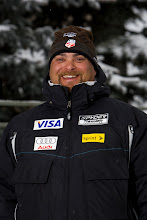
A friend of mine and current World Cup coach, Pete Korfiatis, suggested I write something with regard to course setting at the different levels. Your own awareness, pressure, experiences change as you move up the ranks. J3, USSA, FIS, NorAm and World Cup. What responsibilities lie with you, what goes through your mind? Well, as I have tried to outline this one and get some sort of clarity on what to write, which theme to stick to...I decided, it's my blog, I'll do what I want. I will just write away, see what happens. Have a read-through and post it.
I have been in the sport for 38 years or so since my first Pee-Wee Race on Suntanner at Stratton. That must have been 1972? I loved those races. The little wood blocks awarded with a black, blue or yellow ski school pin embedded in it. Or even better, the "Best Time of the Day" award.
I digress. I am entering my 24th season of coaching. My first year was at St. Lawrence University in 1986-87. I was a 5th year senior with no NCAA eligibility left. I needed a gym credit and worked in trade with the ski team and with Tom Aicher, my friend and our alpine coach that year. Tom had graduated in 1985. We were winging it. Clueless and trying hard to get it right. We didn't really know how to do anything. Hotels, entries, meetings, FIS entries, state associations, drills, radios, chargers. Forget course setting skills. We did our best and worked it out. And got a lot of help from Horst Weber and the coaches at NYSEF.
When I went to work at Stratton Mountain School in the fall/winter of 1987 I knew I was doing what I wanted to do and truly wanted someone to give me a leg up. I could talk the talk and work hard and all of that. Fritz Vallant was the Head Coach there at the time and was famous for telling you to "figure it out!" When Fritz left to go to some FIS races along with most of the rest of the staff, I was left at home for a weekend training session and was told I would be setting the first run of GS for the Janeway Cup GS. A USSA Master's race on North American. I started shaking almost immediately and tried to beg out of it. I had not even set a training course yet that year. Fritz simply said, "don't worry Needle, you're a natural." It turned out fine. I raced and trained on that hill my whole life. It should have been easy to set on and it was. I knew the things I hated to try to execute on that hill and avoided them. Later that year, I also set a FIS GS at Owl's Head in Quebec. It was one of those things where it was sprung on me at the meeting the night before. I stammered and said, "ok." I was there alone with girls and boys, some of the girls were in the first group so they felt it was correct form to offer.
That one turned out fine too. It was an extremely narrow trail with lift towers involved. A lot of work. All I could think of was to try not to set "into" any towers or trees.
After setting a hundred of race courses or so and maybe even a thousand training courses, I was standing on the side of my first World Cup as an insider and "inside the fences." I had been to all levels, I had set everywhere and all levels. I had set training for our World Cup boys that fall. I was ready to set a big time race. Unfortunately, that didn't happen for me my first season. But I did get to help Dave Kerwynn set SL in Kranjska Gora and was involved intensely in the process. I knew from going to almost every course set that season that this was a different deal.
I set 14 World Cups in 6 years including the World Championship Combi SL this past season. I don't get nervous anymore when called on to set. That wasn't always the case.
World Cup course setters are assigned by nation (with some rules) for the entire season in early October. So everyone knows who is setting which race for the whole year. Tendencies are studied and collected. The first run is almost always set the night before the race. This brings at least one coach from each nation onto the hill behind the setter. As well, you have World Cup Race Director, Guenther Hujara present and Technical Discipline Director Hans Pieren there as well. Plus another handful of assistants, local dignitaries, the TD, local coaches and staff, hill staff, media. It's a busy hill. Everyone behind you is measuring the distance of every gate whether it is GS or SL. Counting your turns, measuring vertical distances as well. It can be very daunting. Not to mention that Hujara is there pointing out camera angles as well.
Flachau, Austria, January 2004: Home of Hermann Maier and the Apres Ski Temple, Hofstadl. You have to check out the Hofstadl if you are ever there. Crazy.
I got my first course set assigned. First run of a World Cup Slalom. I had my plan, knew exactly where I wanted to go and what distances I wanted. And thankfully, Flachau is a relatively benign hill. It was very icy however. I started off with my helpers and started getting into a rhythm. I was setting along and there were a lot of coaches out there looking at the course. But this was before the tape measure really got going. So, we were feuding with the Austrians a bit due to the dissolution of our training agreement along with some other little battles and they knew it was my first World Cup set. So I get about 2/3 done and they come down with a little chain. Which is marked with 4 labels. 15m, 6m, 4m and .75m. Of course measuring legalities. But we don't know if their measurements are correct, etc. I complain to Hujara about it. He looked at me and shrugged. He said it looked about right and I had to go change some of my combos which I had measured with ski length. They laughed and taunted. I laughed and vowed to get even. I finished my job, the course ran well and my first one was in the books with little issue. That week, I bought a tape measure, took a clip from one of our ripped GS panels and built my own tape. The first of it's kind. And showed up at the next Austrian SL course set (Wengen) and started measuring for real. We all got a good laugh out of it but by the time we got to the World Cup Finals, Liski had build one from a logger's tape and everyone had one. Every gate of every slalom course has been measured since then.
I have had a lot of opportunity to set at the World Cup and have always been amazed at how much input the FIS gives you. Everything from safety issues to speed control to TV towers and angles they want to see. For instance, the basketball turn in the GS at the bottom of Adelboden is basically demanded by the Race Director as necessary due to camera angle. And he really would prefer if you used a delay to give the camera man a reference.
Since my first set in Flachau there have been a number of setting rule changes in slalom. 15m maximum to 13m maximum. 55(52) minimum turns, to 55 minimum, no tolerance to 30-35% of vertical drop in meters. All in an effort to create a shorter turn shape. To make the guys slide more and therefore go slower. This has worked to an extent but course setters on the WC have tried to push back out to 11 or 12m slalom. Some hills allow it, some do not. What the last rule change did was make the longer, steeper SL hills even more difficult by putting more turns on them and the shorter ones easier because you no longer have to fit more gates on them. Kitzbuhel has become easier to set on, Wengen is exactly the same and Schladming has become more difficult. Schladming has become more difficult to set on and to ski.
There has been an effort by the FIS to slow the athletes down through rule adjustment and lowering of stand-heights. To reduce carving, in short. We have seen the changes happen and the tendency has been for the course setters to barely make minumum turns. To make the distance as easy as possible for the athletes. To test certain skills like turning but to let them shine and look good. When I was working on the FIS tours and NorAms, the focus was really on fairness for the field based on the snow conditions, safety and then on testing skills. I always like the athletes to show me who can turn. And trying not to set something tricky. When I got to the World Cup a lot of the focus became speed control and safety. I always looked at it on the World Cup as a 3 way goal: let the athletes have fun, let the athlete shine and to let the hill shine. We can look at it the same way at a FIS race. The comment I am really hoping to hear from an athlete who just finished a course I had set is that it was fun.
As I said before, I don't get nervous setting anymore, but I always have a plan. And I always hope the athletes enjoyed it.
Course sets for the USA this season:
Women:
Trevor Wagner set run 2 in Soelden last week.
Seth Macadam has run 2 of the slalom in Lienz, Austria at the end of December.
Alex Hoeldelmoser has the SG at WC Finals in Garmsich which winds through the woods and is a challenging hill.
Men:
Chris Brigham has the SG at Lake Louise as he did last year.
Pete Korfiatis has the first run of GS in Val d'Isere. This one is interesting because they had originally said they were going back to the old hill. Rumours have it that they will race on the Bellevarde, the World Championship hill. A much more challenging set and almost impossible to let the athletes look good.
Rudi Soulard has run 2 of the SL at Adelboden. Super steep!